Showing posts with label Simulation. Show all posts

25 Apr 2014

Kinetic Energy Recovery Systems


In F1 one of the technologies uses is the KERS (Kinetic Energy Recovery Systems) also known as Hybrid Power System. The KERS are used within the automotive racing industry in order to reuse the kinetic energy under braking. This recovered energy is then stored in a flywheel or high voltage batteries. This is why when the system came into F1 the engineers were all spotted wearing protective gloves when attending to the cars. These systems are now also incorporated into public transport (such as the Cambridge Passenger/Commercial Vehicle Kinetic Energy recovery System.

KERS has tended to be at the higher end of the Motorsport industry, however now seems to be slowly moving towards making road going cars more green. GKN is to acquire the Williams Hybrid Power and re brand it as GKN Hybrid Power.


This change could offer up to 30% reductions in emissions simply by harvesting the energy that is lost through heat under braking. Another great example of how an often scrutinised sport is really the driving force and leader for what we may next see in our everyday cars (Perhaps not 120kW of addition power though)! 


Williams F1 have also been utilising Autodesk Simulation CFD motion to great use on the aerodynamics of the vehicle. Check out the improvements to the software in the 2015 release.

JLA

13 Dec 2013

Nvidia Maximus - for all your rendering and simulation needs

Another month, another graphics card solution from nvidia.  If you are embracing simulation analysis in your design workflows but are spending far too much time waiting for your solutions to finish and release your system back into a usable state, nvdia have an answer.


This time they've brought out technology that should catch the eye of most designers and engineers in the field - a single-system solution for combining rendering capability with simulation analysis in the form of a dual card set-up known as NVIDIA Maximus.

Making use of an nvidia Tesla card to take the brunt of the computational work in your system, you're free carry on your design work with the additional power of the Quadro card.  Exploring further design ideas while your first iteration is being solved in the background is an extremely productive way to work, and may help alleviate your growing addiction to coffee breaks.


The hardware is backwards compatible with existing machines and the official marketing page (linked above) provides system designers with enough information on how to implement this technology.  It may  be an idea to use it in conjunction with something a little more beefy than a Celeron.

As yet we don't have specific performance graphs of Autodesk software, but as soon as I can convince one of the Micro Concepts shareholders to buy me a package for the office, I'll get my excel spreadsheet out and start number crunching with the Tesla, and posting pictures with the Quadro.

SC


10 Oct 2013

Simulating and saving cash

CFD (or Computational Fluid Dynamics) is another rapidly growing simulation environment that is being utilised with ever increasing popularity in the engineering world. This cost and time saving facility is a base of numerical solutions that allow users and their companies to build environments simulating fluid and heat flow.

As you can imagine in certain industries, (Oil and gas for instance) testing for miles of transportation piping networks would be colossal in terms physical practice. CFD simulation packages however enable us to develop and apply physical changes without increasing labour, material usage and that ever increasing importance of lowering carbon footprint.

Autodesk is running a competitive Simulation CFD package, after consuming Blue Ridge and developing the program  further (previously known as CFdesign), this product is now fully available and from recent use I can confirm it has an easy to use interface with fully developed numerical solutions to manufacturers problems. 

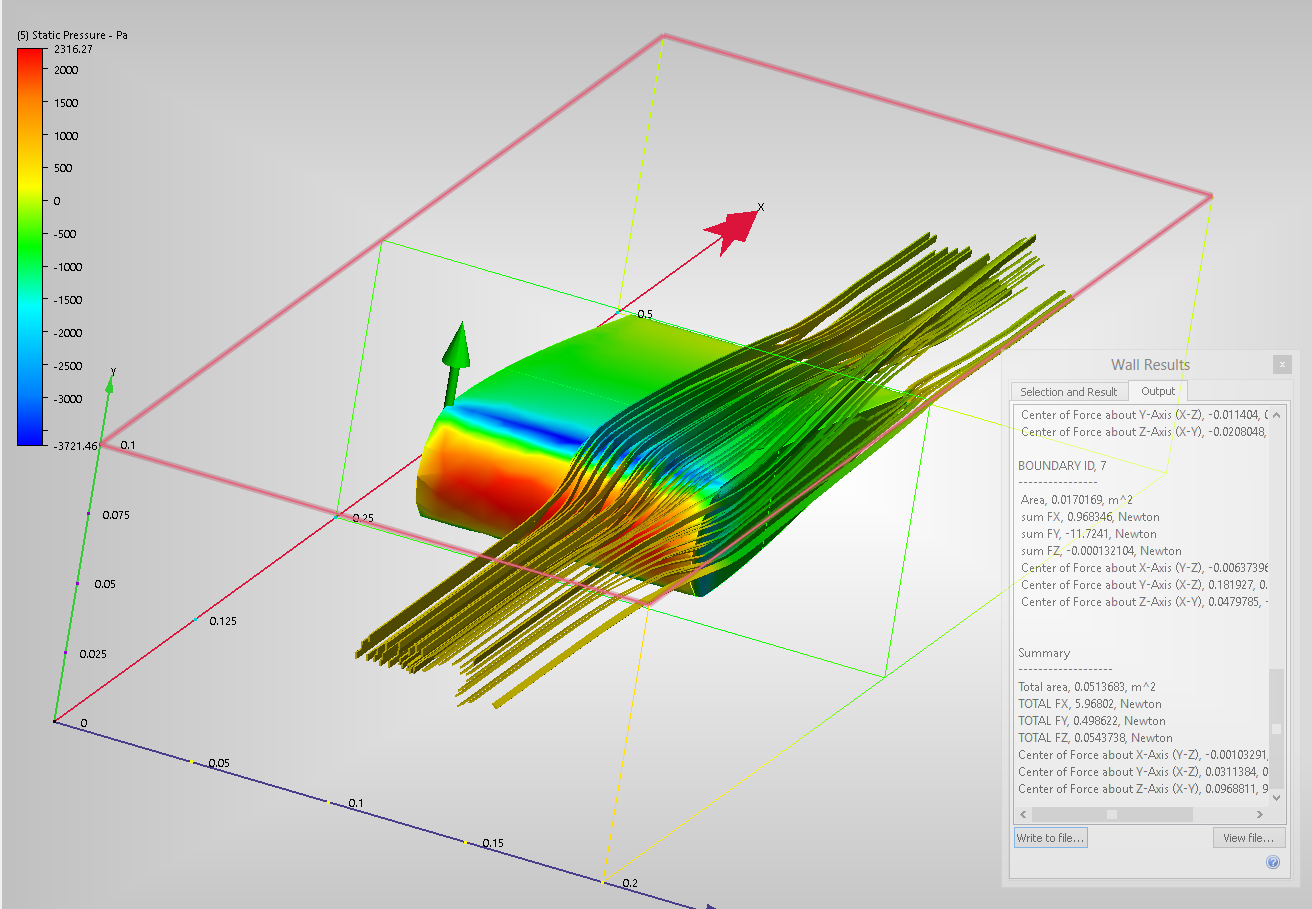
I spent less than 5 minutes knocking up a simple Aerofoil, of which I saved and placed into Simulation CFD as a parasolid.xt. After getting to know the software and applying the correct parameters I had a fully working model that was showing vector displacement, ribbon flows and aerodynamic forces working on the aerofoil. This aerofoil above was run using external incompressible flow. 


Autodesk website has a fairly extensive list of tutorials that are easy to run depending on your modelling skills:

http://www.autodesk.com/wikihelp-cfd-tutorial-2014-enu

4 Oct 2012

Project Hydra for Autodesk Simulation Multiphysics/Mechanical 2013


Project Hydra is a free technology preview that is compatible with Autodesk Simulation Multiphysics 2013 and Autodesk Simulation Mechanical 2013 software.

The features of the Project Hydra technology preview include:
  • Improvements to the Parametric Design Studies (PDS) feature
    Some improvements to the previously released (in Technology Preview Project Scout) PDS include the ability to export results as a CSV file and the support for CAD additions such as bolts/joints as well as remote loads and boundary conditions.

  • Import temperatures from Autodesk CFD
    Temperatures from Autodesk CFD can be imported to linear, thermal, and MES analyses. Both steady-state and transient Autodesk CFD results can be imported as appropriate. To use this feature go to the respective Thermal tab in the Setup->Parameters dialog and choose "Simulation CFD file" as the "Source of Temperature."

  • New fast Subspace with AMG solution of dynamics analyses
    For larger dynamics (modal, natural frequency) analyses with relatively small numbers of needed frequencies, a faster solution option is available: Subspace-AMG. The dynamics analysis solver will automatically switch between this new solver and the pre-existing one depending on the size of the model and the number of frequencies requested.

  • Inquire results by part
    A new capability that allows the user to inquire the displayed result of any analysis on a per part basis has been added.

  • Improvements to the Drop Test Wizard (DTW) feature
    The DTW from Project Scout has also been improved in Project Hydra.

  • Rerelease of the GPU-enabled AMG Solver (AMG-MF)
    The Project Scout AMG Solver (AMG-MF) is being rereleased in this Tech Preview. This solver is faster than the original AMG solver for a class of well-conditioned and bulky models. Additionally, this solver can utilize a supported NVIDIA video card if requested.
Availability:

The technology preview will operate until April 1, 2013.

You can find the download on Autodesk Labs a:

http://labs.autodesk.com/utilities/hydra


22 Aug 2012

LABS - Project Scandium for Autodesk Simulation Moldflow 2013

Project Scandium

Project Scandium for Autodesk Simulation Moldflow 2013 software is a free technology preview that extends simulation capabilities by offering new capabilities to try out and provide feedback.

24 May 2012

Project Factory.Modz() for Inventor

Traditionally machine line layouts in a factory are created with pen and paper or in the form of 2D drawings. Using these means, it is extremely difficult to explain the working intent of the machine lines toclients or internal stakeholders. Using 2D workflows, it is very challenging to account for movement of material, people, and material handling devices and show them interacting with each other inside the facility. The inability to clearly articulate the working intent often results in losing bids to competition and the inability to sell ideas to stakeholders.

27 Jan 2010

Autodesk Algor Simulation Express for Autodesk Inventor

Experience Autodesk Algor Simulation software by downloading the free Autodesk Algor Simulation Express software - an engineering simulation tool that allows you to perform a first pass of design validation and optimization before manufacturing.

Autodesk Algor Simulation Express software is an engineering simulation tool that allows you to perform a first pass of design validation and optimization before manufacturing. It allows designers and engineers to perform linear static stress analysis of single-part CAD models and virtually test the behavior of product designs, speed up time to market and make better, safer products at a lower cost.

Autodesk Algor Simulation Express software helps introduce manufacturers to the Autodesk Algor Simulation product line, part of the Autodesk solution for Digital Prototyping. The Autodesk Algor Simulation products provide a wide range of tools to help perform accurate, efficient simulations and collaborate in a multi-CAD environment.

By providing an entire range of validation and optimization tools within the same easy-to-use interface, Autodesk Algor Simulation software lets designers and engineers start with mainstream tools and then expand their toolkit to include more advanced analysis such as Mechanical Event Simulation (MES) and Computational Fluid Dynamics (CFD) - without the need to learn new workflows.